

Discovering an ant that accidentally got in on a piece of clothing left outside is one thing, but discovering them every day is quite another. It's a sign that these aren't just stray ants. They're following a specific path that leads them to a food source.
Needless to say, an uncontrolled ant problem can quickly become widespread. Here’s how to prevent them from entering your home.
What attracts ants inside?
Ants are attracted to sugary and starchy foods. They are also affected by extreme temperatures. For example, during heavy rain or periods of intense heat, some ant species might be tempted to re-establish their colony inside your home, especially since they will likely have easy access to food and water there.
Food that is easily accessible to ants
Without you necessarily knowing it, your house is an all-you-can-eat buffet for insects, especially ants, which are not afraid to cross your path.
Spilled juice, a drop of honey, very ripe fruits on the table, breadcrumbs under the toaster, dry food in cardboard boxes, dirty dishes in the sink, pet food, table scraps in the bin… The choice is vast.
By adopting good habits, you can quickly eliminate easily accessible food sources for ants.
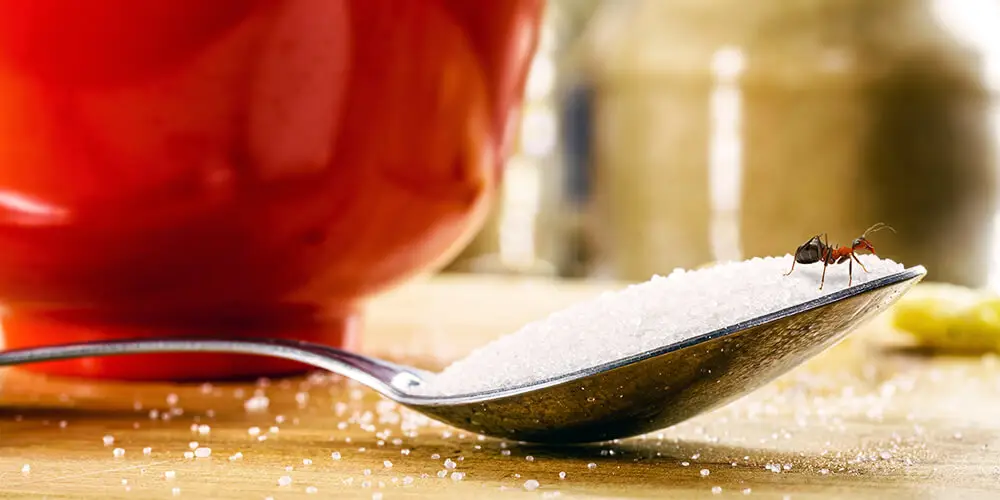
Ants need water
Ants need water to survive, but due to their small size, they don’t need much. They can survive on condensation from a window, a leak under the sink, a plumbing joint that's starting to fail, or water droplets in the bathtub or sink. If necessary, they will make do with the dampness under the shower mat or visit your plant saucers after watering.
Fix any leaks and address any moisture problems. Also, be sure to seal any potential entry points: cracks, weatherstripping, screens, cables and pipes... Consult our guide to learn how to prevent infestations.
How to solve an ant problem in the house
If you regularly find ants in your home, you'll need to address the problem at its source. You must intervene before they enter and eliminate any colony established too close to the house. This includes the queen, which will lay thousands of eggs during her lifetime, thus ensuring the colony's survival.
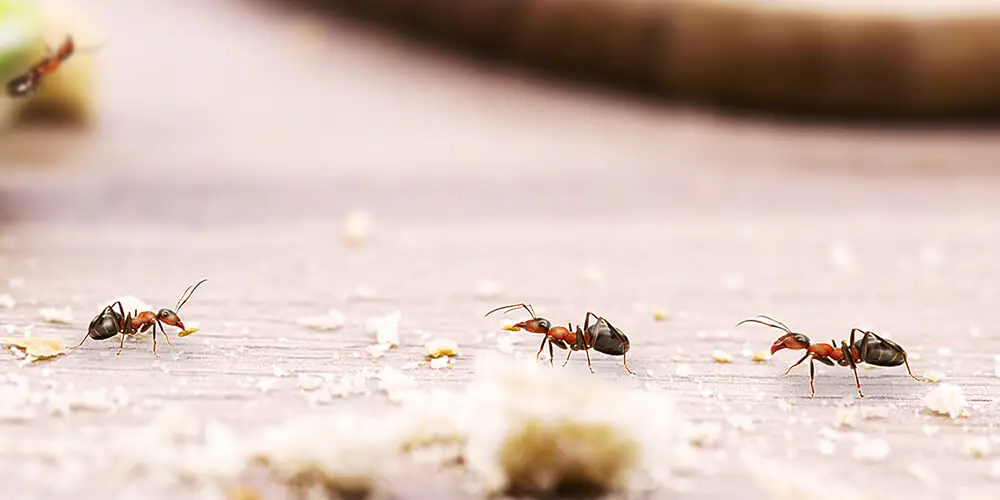
To locate a nest, observe the movements of ants. By following the path of an ant carrying food, you can almost always discover the colony's location. Conversely, you can probably also discover how ants are entering your home. Their movements are rarely random.
When an ant discovers a food source, it brings its bounty back to the nest, leaving behind a trail of pheromones. This residue, which marks the food trail, allows the ant to return to the source and also indicates to other ants the path to follow to access the food source.
What products should I use to prevent ants from entering?
Depending on the location of the entry point and the nest, ANT OUT offers various solutions that often resolve the problem within 7 days. The choice of products will be influenced by the surfaces and areas to be treated (patio door, flower garden, lawn, deck, etc.), the extent of the problem (localized issue or infestation), and the desired objective (exterminating a colony, protecting the perimeter, etc.).
Here’s how to choose which ANT OUT products to use to avoid forced cohabitation with ants.
Traps and baits
They contain sugary and protein-rich substances, combining the two types of food essential to ants, as well as borax, a slow-acting destructive agent that gives the ants time to bring the bait back to the nest to share it with the colony before dying. Effective at eliminating an entire ant colony, they solve the problem within 7 days.
Once you have set traps or another bait, don't be surprised to see an increased number of ants. Do not disturb them; the more ants feed on the bait, the faster the colony will be destroyed.
Ant baits
Each pack contains 6 child-resistant baits to be placed near potential entry points. Ideal for patio doors, garages, decks, under furniture and appliances, in flower beds and shrubbery, they will destroy a colony in 3 to 7 days.
Ant traps
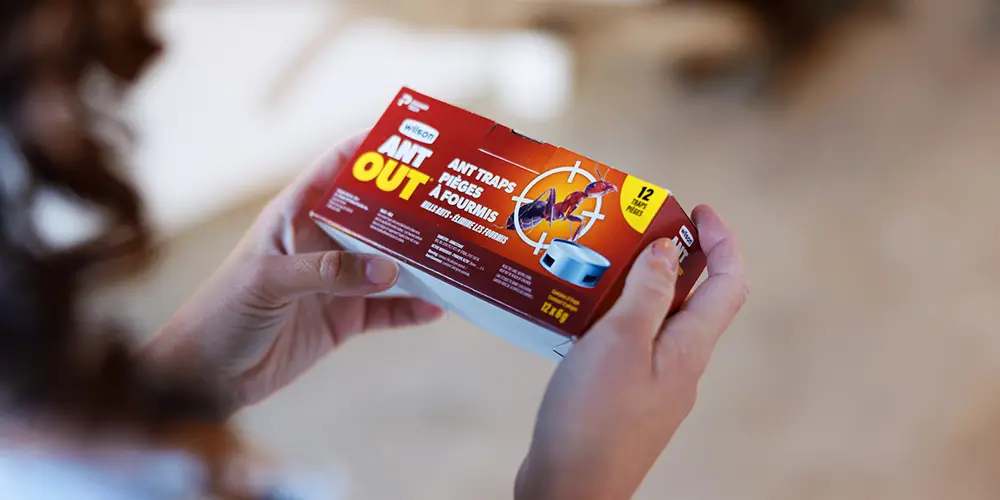
Ant traps are bait stations that also contain both a food source to attract ants and borax. They allow the ants time to make trips back and forth to share the bait with the colony, exterminating it in 3 to 7 days.
Place them in areas where ants travel in the garden, near doors, patio doors, windows, garages, and other potential entry points, but in locations inaccessible to children and pets. Drill four holes to allow the ants easy entry, and space the traps 1.5 to 3 metres apart to cover as much area as possible.
Ant stakes
Extra-long ant stakes are designed for easy installation in lawns and flower gardens. They are placed near foundations, entrances, walkways, porches or patios. Place them close to the nest and let the ants carry the bait back to the colony. They allow for easy elimination in just 7 days.
Solutions for treating large areas
Ant Killer with battery sprayer
Ideal for treating house foundations as well as patios, decks, walkways and driveways, ANT OUT Ant Killer with battery sprayer allows you to easily treat large areas. Its effect is fast and long-lasting. Repeat the treatment only after 7 days if the ant infestation persists or reappears.
Treatments for repairing cracks and hard-to-reach areas, and for protecting access points
To deter ants from entering the house, treat the foundation walls as well as the areas around the doors and windows of your house with ANT OUT.
Ant Killer Dust
Made with diatomaceous earth, ANT OUT Ant Killer Dust is an environmentally friendly and proven alternative to chemical pesticides used to kill ants. It is not toxic to humans or pets (dusty substances may cause discomfort when inhaled; it is recommended to avoid breathing them).
Ready to use, ANT OUT Ant Killer Dust is easily applied around the perimeter of your home to create an effective barrier. Ants attempting to cross it will be exterminated within just 48 hours of contact with the dust. It can also be applied along ant trails, both indoors and outdoors, on lawns and near plants.
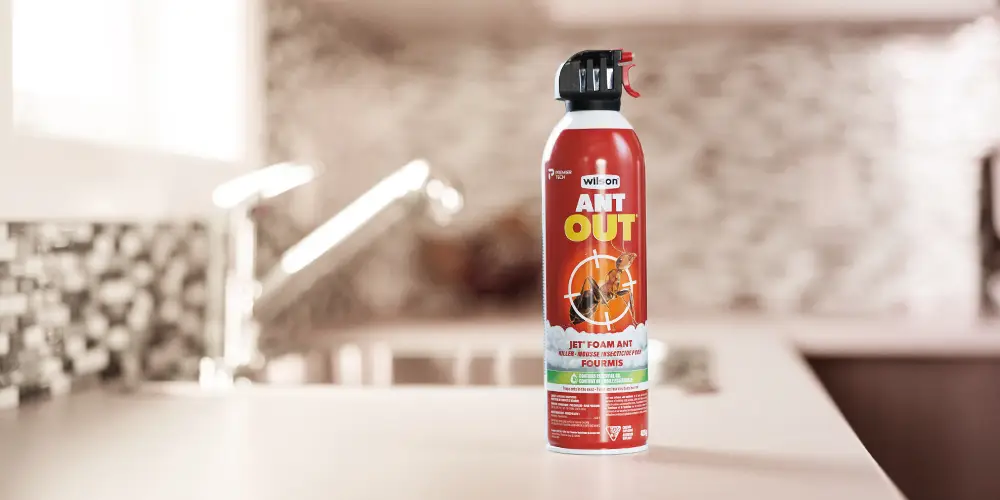
Jet Foam Ant Killer
Sold with an extension tube that allows for the treatment of crevices and cracks both indoors and outdoors, the foam allows for targeted application and is used as an additional treatment around foundations and between joints in patios, pavers, walkways, entrances, balconies and decks.
When should you call an exterminator?
Ants entering the house during the warmer months are an easy problem to solve with ANT OUT. The real cause for concern is when you see ants inside as early as February, or in early spring when it's still cold outside.
These are most likely carpenter ants, whose life cycle and seasonal behaviours have adapted to life indoors. They can cause significant damage. To resolve the problem quickly, learn how to identify them as well as how to act.
