

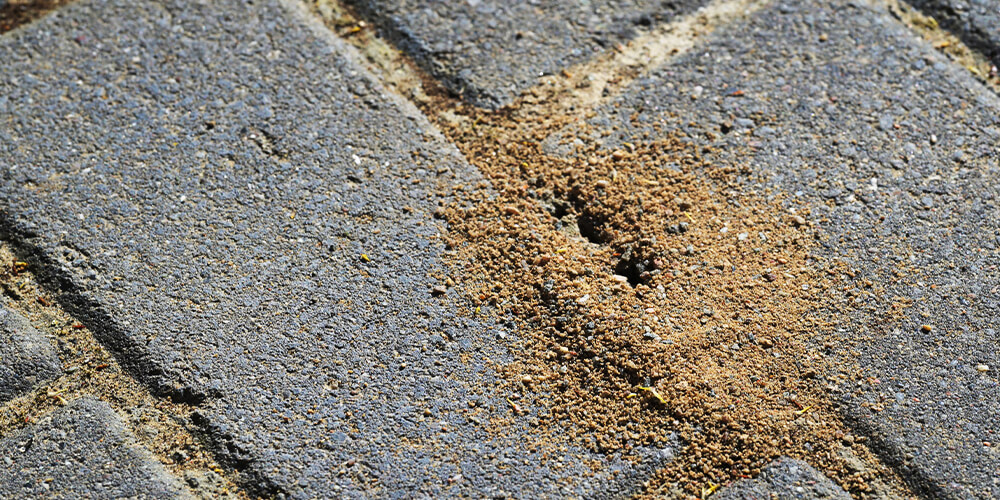
Since spring has arrived, you’re probably noticing tiny piles of sand showing up between the pavement cracks. You kick one of the mounds flat. But the next day, it’s back. Well, guess what? The overwintering pavement ants are waking up!
Away from the house, ants aren’t really a problem. But once they get close to your house, you should be aware that the scouting ants are always looking for food. They are known to feed on both greasy and sweet foods, and your house is stocked. So tempting!
The key is to keep them away from your deck or patio and to block them from entering your house. With a little preventative work, this is entirely solvable.
What do pavement ants look like
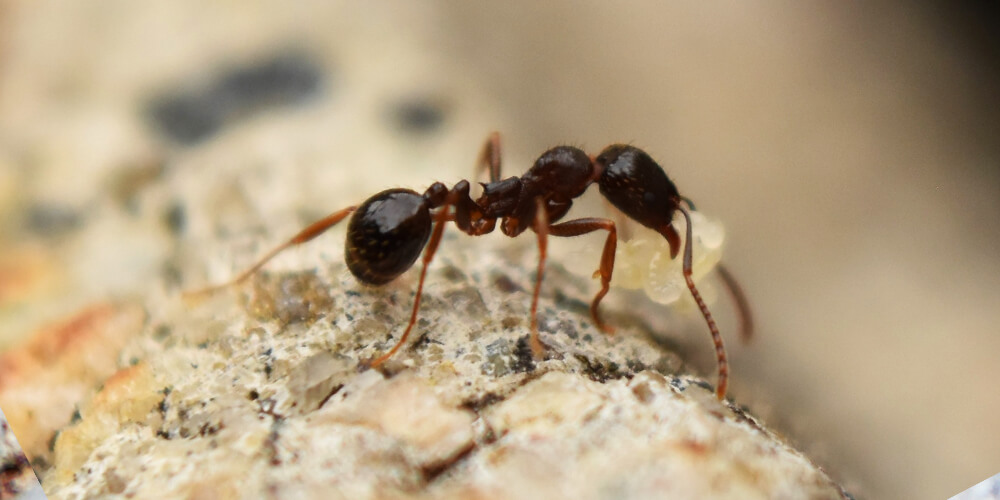
Pavement ants are the small, reddish-brown ants that you see along pavement and sidewalks. They’re 2.5-4 mm in size (1/8-1/6 inch) and have visible grooves on their head and thorax (upper body).
Compared to the much larger carpenter ants, which size up to 6-12 mm (1/4-1/2 inch) and have shiny reddish-black bodies, pavement ants do not damage wood structures like carpenter ants and are not known to bite or sting humans. But they can be a nuisance if they decide to cozy up to your house.
Why are they called pavement ants
The pavement name comes from their tendency to establish nests under the shelter of pavement used for sidewalks, patios and driveways. During winter, they hibernate under the pavement, and come spring, they are out to repair and expand their tunnels. They end up pushing all that displaced soil to the surface.
How a pavement ant colony works
Here’s what’s under that pavement: a queen ant, her eggs, larvae and pupae, many female worker ants, and in smaller numbers, winged male drones. The queen stays in the nest, laying thousands of eggs, the younger female worker ants feed the larvae and do nest maintenance, and the older female worker ants go out and forage for food. The non-working winged male drones, which appear in late spring and early summer, are around just for the breeding and then die off. A typical colony could include several thousand ants.
Why are pavement ants in your home?
As their name indicates, pavement ants tend to end up where they can make a nest under pavement. But they need food. In nature, they eat dead bugs, seeds and nuts, and need access to water. There’s not much food or water in a paved parking lot, but there’s plenty where there are houses. Pavement ants love greasy foods, meats, cheeses, ice cream, bread, cookies, pet food, sugar, honey and fruit. And there are plenty of those goodies in and around the house, garage, patio or deck.
Since all they need is by your house, pavement ants end up building their nests close, along edges or cracks around pavement, patios, driveways, sidewalks, rocks and foundations. Once the nest is established near the house, their scouts will look for food and ways to get to it.
They’ll search for cracks in the foundation walls or concrete floors, where utility pipes, cables and vents enter the house, or through basement windows and ground level doors. The ants are quite tiny, so getting into your home is extremely easy for them. If a scouting ant gets inside and finds a food source, she’ll leave a pheromone-scented trail for other workers to follow.
During the winter, worker pavement ants are typically dormant. However, nests constructed near or beneath heated structures may continue to be active, which means the ants might come inside looking for food and water.
Occasional visitors or permanent invaders?
Usually, pavement ants come in and forage indoors to return to their outdoor nest. In doing so, they are not just a nuisance, they can also spread food-borne illnesses from their activities around rotting food. You should know that quite a few of their visits might end up being attempts to move inside permanently. While pavement ants do live under sidewalks and driveways, they often look to establish indoor nests, particularly in the fall to escape the cold, or in the spring to take advantage of the warmth.
Preventing pavement ants from getting inside
Your first line of defense starts outside. Cutting off access points and eliminating conditions that attract pavement ants around your home's perimeter is the most effective way to stop an infestation before it begins.
How to proceed:
- Eradicate outdoor colonies around the house (more on that later).
- Look for any foundation gaps or cracks outside and seal them.
- Ensure caulking is tight around windows and door frames.
- Repair damaged window screens, especially basement windows.
- Install new door sweeps on every outside access door, if needed.
- Replace old and brittle weather stripping.
- Eliminate moisture around the house, such as leaky outdoor taps, downspouts, etc.
- Check around pipes, dryer and HVAC vents, and other access points for cracks or gaps.
- Prune vegetation that is growing close to or touching your building.
- Don’t stack firewood against the house.
- Clean up food crumbs and spills after barbequing and eating outdoors.
Flying ants: a seasonal warning sign
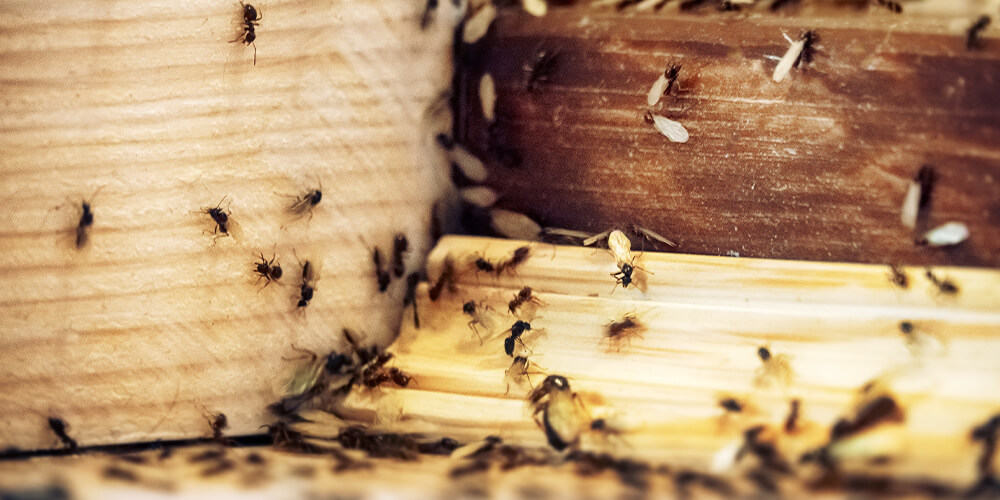
In early summer, you might observe swarms of winged pavement ants. These are reproductive male and female ants. This is a short-lived activity. After mating, the male dies, the female loses her wings and looks to set up a new colony. They have been known to fly inside houses, instead of the usual method of crawling in. So open windows and doors are a new way to get in. A recently mated female swarmer ant can start a new colony indoors, though it is not her preferred place.
One thing for sure, if you see swarming ants, you definitely have a colony nearby. If you see a lot in your house, then the colony may be inside!
How to get rid of pavement ants
First, control the outside agitators and create a barrier to prevent others from moving in on your house.
Use ANT OUT Ant Killer Spray to treat the perimeter: foundations, under eavestroughs, around light fixtures, and places where ants enter (e.g., screens, doors, window frames). You can also apply it to garbage cans and localized areas of patios, porches and decks. To disrupt their regimen, spray along ant trails, into ant nests and at points of entry. Treatment can be repeated after 14 days if pest problems persist or reoccur.
To treat cracks, crevices and nests, use ANT OUT Jet Foam Ant Killer. Insert the extension tube as far as possible into hills, mounds, cracks, crevices, gaps, voids and trails in driveways, patios, sidewalks or interlocking bricks where ants hide, and drench until foam fills the area. Stop spraying when the foam comes back from the crack or crevice.
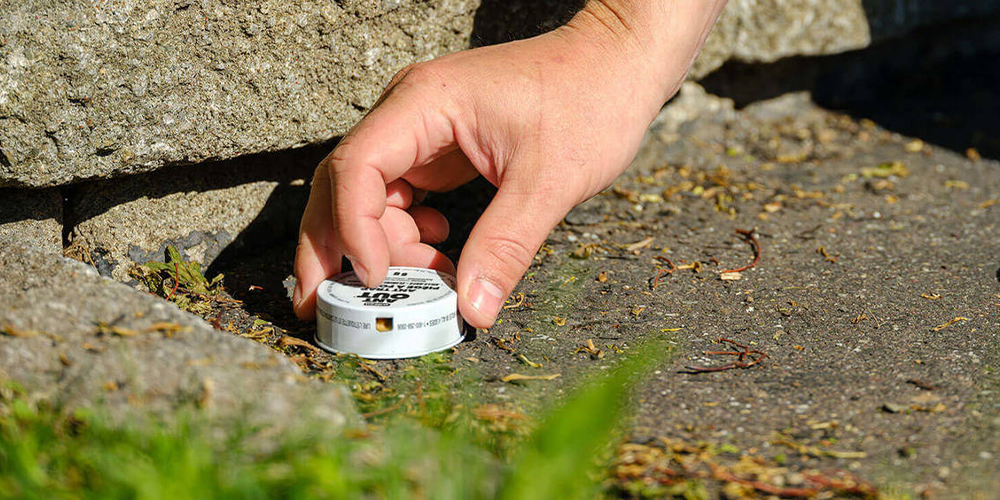
Note that Ant Baits are the only surefire way to kill the queen and the whole colony. While sprays get rid of ants that you can see and provide a protective barrier, they may not get the whole underground nest. With bait stations, worker ants carry the bait back to the nest, feeding it to the larvae and the queen. The delayed action allows the bait to spread through the colony before workers die.
Place ANT OUT Ant Bait Gel or ANT OUT Ant Stakes where ants are seen, such as near doors and other entrances, next to patios, around house foundations, garages, sheds, in potted plants, and in and around garden beds. Place next to ant mounds (not directly in).
ANT OUT Ant Killer Dust’s diatomaceous earth is an alternative to chemical pesticides when trying to kill ants. This natural powdery substance is made from tiny fossilized aquatic organisms. It is combined with two food grade additives, one of which attracts ants while the other is a digestive agent. When applied directly, crawling insects are usually killed within 48 hours.
Use it in areas where dust application cannot be affected by heavy rain or high winds. Lightly coat areas where ants are seen or may hide, including building foundations, window and door sills, patios, porches, along ant trails, around gardens, under hedges, shrubs and trees, and directly on mounds.
If you can control the pavement ants when they first appear outdoors, plug the gaps and points of entry and keep your place clean, you’ll be well ahead in preventing a home invasion and avoiding unwelcome visitors. But if they find their way inside, there are easy solutions. Bait and disrupt.
Most ANT OUT products can also be used indoors (check the packaging or our website for any contraindications). To address an ant problem inside your home, explore our other article to find out which products to use and where, for fast and effective results.
