

If you're seeing carpenter ants inside your home, you have a problem that won't go away on its own. Unlike termites, carpenter ants don't eat wood, but they tunnel through it to build their nests. The damage is often invisible until it's serious: hollow beams, weakened structures and colonies of thousands hidden inside your walls.
With the right approach, you can identify, eliminate and even prevent a carpenter ant infestation. This guide walks you through every step.
How to identify carpenter ants
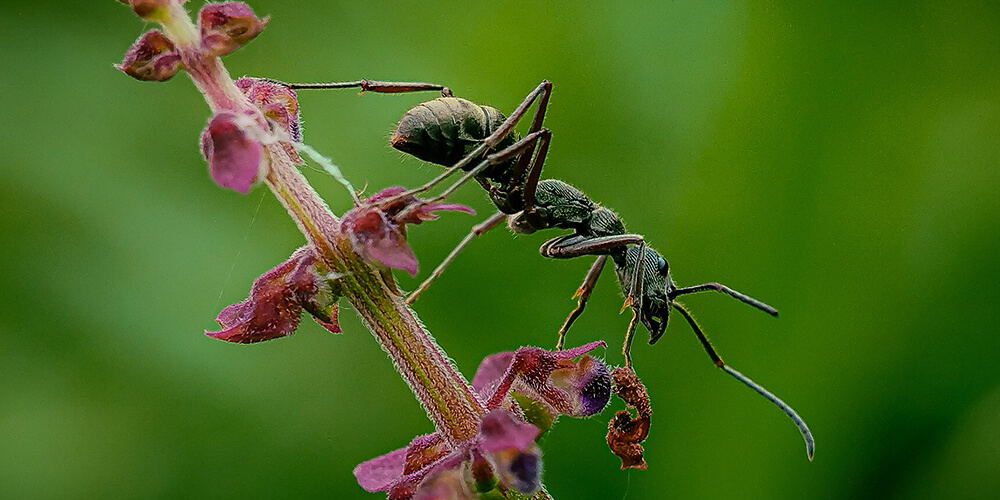
Carpenter ants are the largest of the ant family. You’ll distinguish them from regular ants as the big black or dark brown ants, bulking up at 13-25 mm (1/2-1”) long. Their body is divided into 3 segments, with a smaller waist separating the upper and lower body.
Carpenter ant colonies are large, social insect structures containing hundreds to thousands of workers, a queen and winged reproductives. Some males and females will have wings during the short breeding time… And they’re the only ants that chew tunnels in wood.
Where do carpenter ants nest outdoors?
Outdoors, carpenter ants nest in rotting wood near the ground, inside hollow trees or under rocks. You’ll find them in moist rotting stumps, logs and dead tree limbs. Since they are mostly active at night, you may not always see them. They primarily consume sugary liquids, such as honeydew (aphid secretions), sap, fruits and nectar, along with insects, seeds and fungi.
When the colony grows too big, satellite colonies need to be established. In late spring or early summer, winged male carpenter ants mate with flying females, but as often in the insect world, the males die right after their usefulness is no longer needed.
Where do carpenter ants nest indoors?
The bred female looks for a location to establish her new satellite colony. If your home is close enough, she will usually search for a small crack in a wooden structure. Soon after, the female loses her wings. She then lays the first set of eggs after sealing herself inside that chamber. Until her first batch of eggs develop into adult workers, she stays within that initial chamber.
The only role of the queen is to lay eggs, and as soon as worker carpenter ants mature into adults, they take on the responsibilities of the colony. They dig tunnels to broaden their nest to accommodate the growing population. They seek food and care for the eggs, larvae and pupae.
Entry points: how carpenter ants access your home
When the newly bred female is searching for a new location, she’ll be looking for moist or damaged wood such as cavities in decks, porches, around windows and doors, eaves, fence posts and railings, crawl spaces, attics, garden sheds, etc.
She’ll be making sure that there are many sources of food nearby: insects, both alive and dead, plus a range of plant nectars and juices, honeydew, syrup, jelly, sugar, salt, fruits, meat, grease and fat. That’s why houses look like promising new locales. Even if the nest is not directly inside the house, the food source might be. The worker ants will seek an entrance looking for food.
Carpenter ants usually enter homes through cracks and other openings in the foundation, by utility entry points (air conditioning, electrical, water, drier and other vents, HVAC, etc.), crevices around doors and windows, and even along branches and electrical wires in touch with the roof. They can also enter your home as hitchhikers on firewood.
Once the worker ants find what they’re looking for, they’ll leave an invisible trail that the other ants can follow.
Signs of a carpenter ant infestation in your home
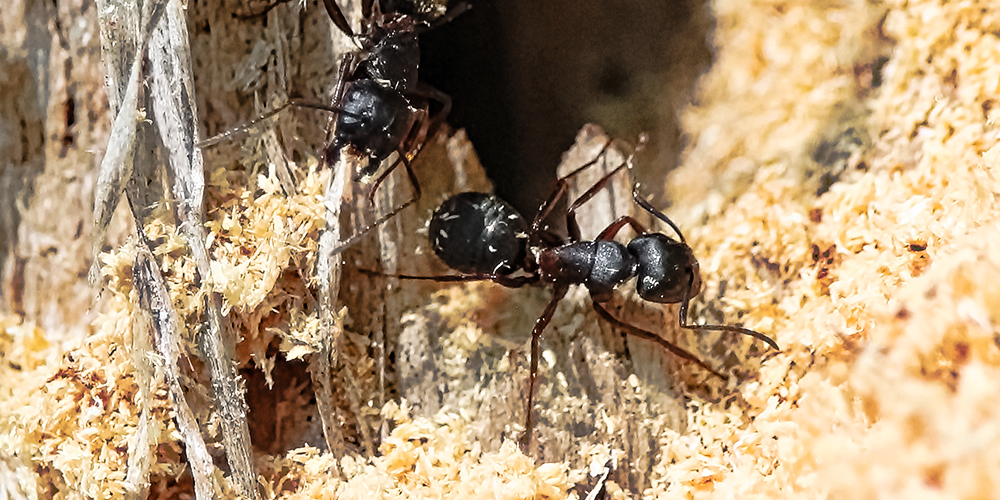
The first indication will be spotting piles of sawdust outside their slit-like openings in woodwork. You might even hear a rustling noise within a wall. Spotting large ants moving in a single-file line is another sign. Seeing them inside your home in the middle of winter, before any ants are spotted outdoors, generally indicates the presence of an indoor nest. Finally, spotting large winged ants inside your home in early spring is a sign that the colony living in your house has reached maturity.
Another thing to remember is that 90% of ants are nestled in the colony and only 10% can be seen out of the nest. If you see a carpenter ant in your house, know that there are a lot more that you can’t see.
Where to inspect for carpenter ants in your home
Inspect areas in or around your house where there is exposed structural lumber or wood in contact with moisture. Remember that these ants prefer moist decaying wood. If you've previously had water damage and suspect there may be damaged wood in the structure, that's the first place to check.
Carpenter ants usually avoid pressure-treated wood since it’s generally resistant to rot and to subsequent ant infestation. But if the treatment is old or the wood is damaged, it might be susceptible to carpenter ants.
Look for a concentration of ants where there might be moisture, such as under the kitchen sink, around basement utilities and sump pump, around improperly installed window air conditioners, under a deck or porch, and attics. See if you can follow them and their invisible trail to lead you to a nest.
6 actions to prevent carpenter ants from entering your home
- Ensure caulking is tight around windows and door frames.
- Repair damaged window screens, and securely screen attic and wall vents.
- Make sure crawl spaces are sealed.
- Install new door sweeps on every outside access door, if needed.
- Replace old and brittle weather stripping.
- Check pipes, roof pipes, dryer vents and other access points for cracks or gaps.
How to get rid of carpenter ants
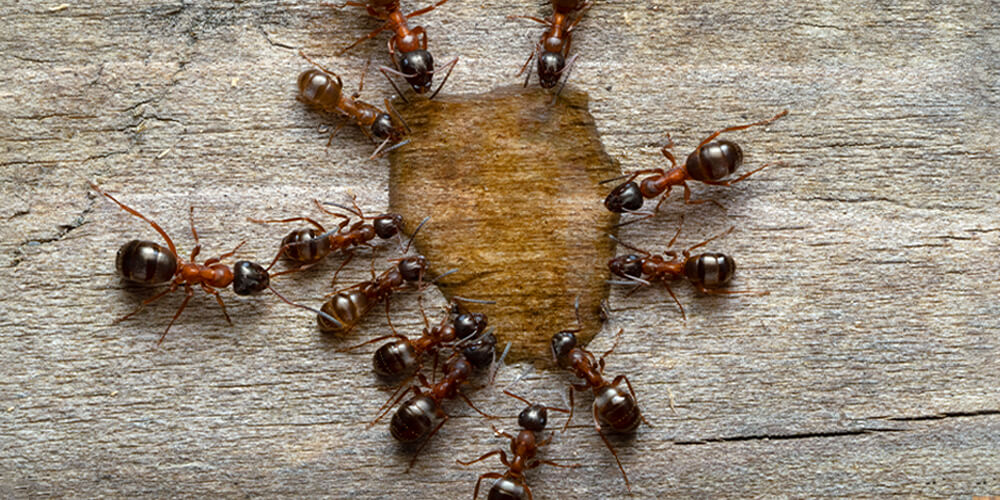
Normally, ant infestations aren’t completely controlled with simple ant killer sprays, as you may be only removing the ones you see. To get rid of all the ants that are hidden in the nest, you need to use ant bait stations, unfortunately designed for the normal smaller-sized ants.
Because carpenter ants’ nests can be difficult to locate and the ants can cause structural damage, by all means call in a professional exterminator. They will be able to locate and destroy the main nest where the queen and the colony reside.
