

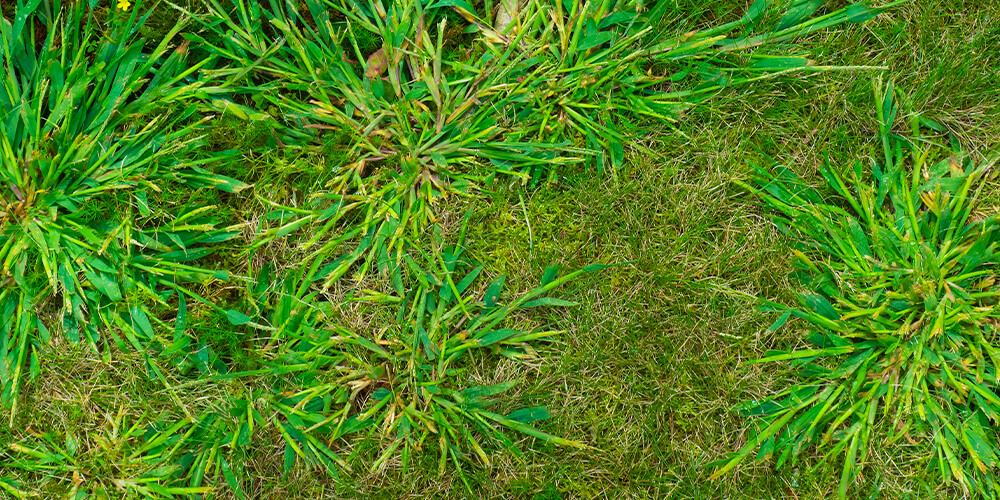
Crabgrass gets its name because its branches, or tillers, develop in a circular pattern to resemble crab legs. As crabgrass grows, the stems lie flat. It is a type of grass, so why can we not tolerate it in the lawn?
Simply because crabgrass is not a "turf-type" grass. Regular grass blades are dark green, fine and upright. Crabgrass grows low to the ground in clumps of light green, wide grass blades. It establishes as a dense mat that has the potential to smother your regular grass plants. Get rid of crabgrass before it takes over your lawn.
Why is crabgrass damaging to your lawn?
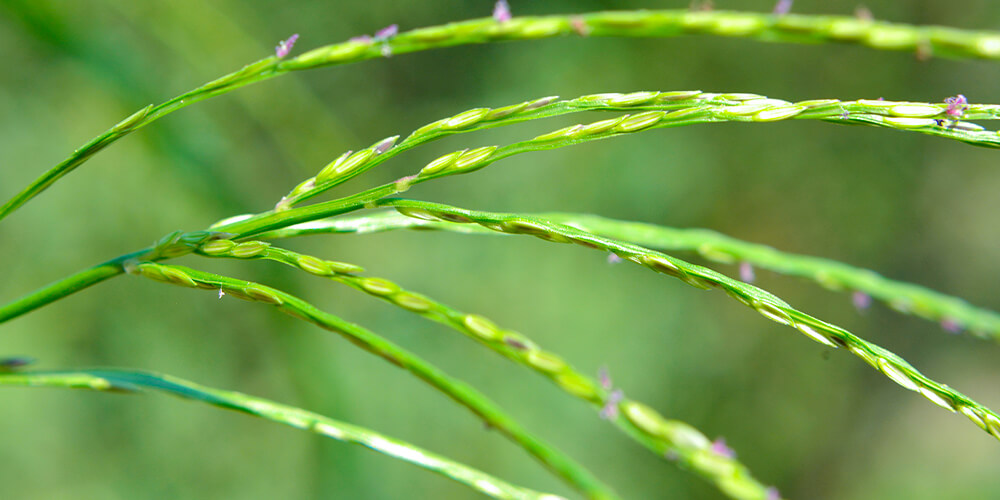
Crabgrass is a nasty weed that can take over sections of your lawn and jeopardize its health. It germinates later, when the weather becomes warmer, and it grows much faster than your lawn grass. As the crabgrass clumps get wider, they turn purplish in colour and produce distinctive seed heads that fan out like claws or crab pincers.
It will choke out your grass plants by blocking out the sun and by limiting water and nutrients from getting to the lawn’s roots. Your grass gets weaker. Crabgrass will then start to crowd out the weakened grass and overtake the section.
The good news is that crabgrass is an annual plant that will die out in the fall. The bad news is that each plant can produce over 100,000 seeds, which are shed onto your lawn or garden area. Oh, and those seeds can lie dormant in the soil for many years, even decades, all the while waiting for an exposed space where they can germinate.
The life cycle of crabgrass
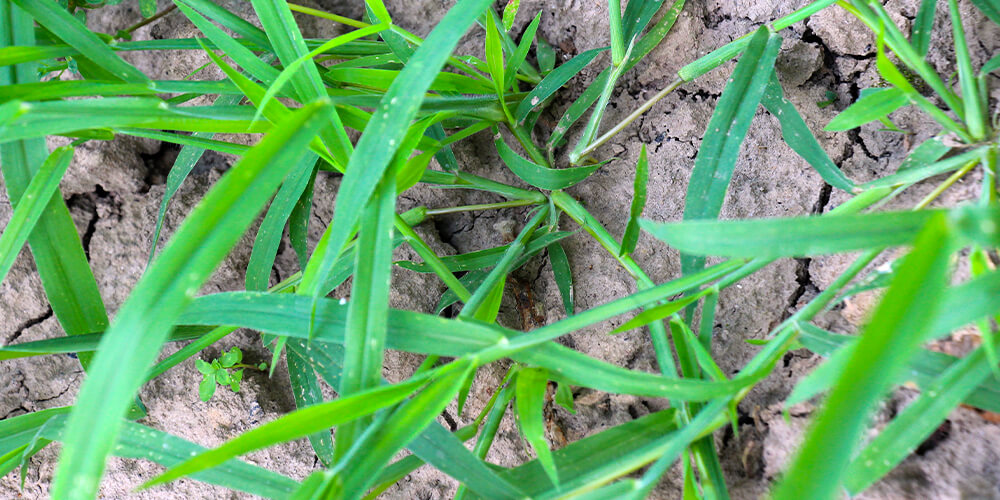
Crabgrass spreads its seeds in the fall with new seedlings sprouting the following spring. Seeds tend to germinate in mid-spring when the temperature is consistently over 12 °C. In the beginning stage, the seedlings resemble miniature corn sprouts that then branch out as flat lime green blades. Because crabgrass grows low to the ground, it manages to escape lawnmowers. It often goes unnoticed in the lawn until later in the season.
As you may already know, crabgrass can grow out of driveway cracks, or even in compacted soil or gravel. It can grow just about anywhere there is an empty space.
This is one tough plant. Because it is an annual plant that will die off at the end of the season, it produces over a hundred thousand seeds and deposits them into any exposed spots to germinate next season. Wind, rain and your family activities will spread the seeds around. New crabgrass seeds are usually introduced into lawns by shoes, lawn equipment or bulk topsoil used for renovation projects. Or from your neighbours!
Why do I have crabgrass in my lawn?
Crabgrass seeds end up wherever the lawn is thinned and stressed from ice salts, drought or insects. You’ll often see crabgrass growing in lawn areas along sidewalks, driveways and boulevards, which are typically thinned out due to ice-melting salts that affect the soil. Sidewalk surfaces are usually warmer because they absorb heat and reflect sunlight, creating an environment that is more conducive for crabgrass seeds to germinate. That’s why you see it growing predominantly along the edges of lawns bordering paved sidewalks and driveways.
Crabgrass thrives in hot, dry weather, and it can take advantage of your lawn. Normal lawn varieties grow aggressively in the cooler spring and fall seasons, but slow down during the hot, dry part of the summer, which is the ideal time for crabgrass to establish itself in your lawn, when your lawn is at its weakest.
What is the best way to get rid of crabgrass?
If you want to control crabgrass, you’ll need to mitigate some conditions. Keep in mind that crabgrass loves:
- Hot temperatures and dry weather
- Soils that are compacted, shallow and/or of poor quality
- Thinned out lawns with areas of bare soil
- Grass that is cut too short or scalped
- Stressed lawns
Controlling this weed requires a strategy, not just a specific product. There are three approaches for controlling crabgrass. Due to cosmetic pesticide bans in Canada, there isn’t any effective selective treatment for emerging crabgrass (that is, one that kills crabgrass, but does not kill lawn grass). The strategy involves a combination of preventing, discouraging and removing crabgrass.
Three strategies to eliminate crabgrass from your lawn
1. Prevent seeds from germinating with a pre-emergent treatment
The most common approach is the preventive one that keeps the millions of deposited seeds from germinating. This has to be done in the spring, when temperatures hit 13 °C, and before crabgrass seeds have germinated. If you had crabgrass last summer, you need to apply a pre-emergent corn gluten treatment in early spring. It will lay down a barrier that keeps the crabgrass seeds (and other weed seeds) from establishing.
2. Discourage crabgrass through healthy lawn practices
- Repair bare areas in the spring with new grass seed. Don’t give crabgrass seeds an open area to start and take over.
- Prevent ice salt damage. Lawn areas by sidewalks and boulevards are affected by ice-melting salts. Salt destroys soil structure by compacting it and prevents grass roots from absorbing water. Drench those affected areas with water first thing in the spring to flush out the excess salt. You can also sprinkle gypsum to help restore the soil structure. Seed or sod afterwards.
- Mow your lawn at a higher height. Your mower should be set at 8-10 cm (3-4”). The taller grass assists in shading the soil and preventing the crabgrass seeds from receiving the necessary light to develop. You should know that longer grass promotes deeper roots and a healthier lawn in general. As a bonus, taller grass keeps weed seeds, like dandelion, from finding bare soil to land on.
- Water deeply and infrequently. Lawns require about 2.5 cm (1”) of water once a week. Remember that shallow-rooted crabgrass prefers dry soil, so deep watering promotes deeper lawn roots and makes the grass more competitive with weeds. Tip: water in the morning to minimize evaporation.
- Fertilize the lawn. Apply a good fertilizer at least twice a year, in early and late summer.
- Aerate your lawn in the spring or fall. Compacted soil is something that crabgrass thrives on. Annual aeration of your lawn loosens the soil profile and provides better air and water circulation.
3. Remove established crabgrass plants
- Pull them out. You can take out growing crabgrass plants simply by pulling them. You’ll need to remove its entire root system, but crabgrass has a very shallow root system. Hand-pulling can be made easier if you soak the area first with water or use a standard lawn weed pulling tool. Proceed before seed heads are formed or bag the weed right away to avoid spreading the seed.
- Use a herbicide spray. There are no post-emergent selective crabgrass killers registered for the Canadian market, but you can use a registered non-selective weed and grass killer product such as Wilson WIPE OUT. Spray any crabgrass growing in sidewalk cracks, along fences, in gravel, around patio edges, etc. Avoid spraying healthy lawn areas. Remove the dead plants afterwards and re-seed or sod.
Crabgrass can be a real threat but, with the right knowledge and timing, it’s entirely manageable. So prevent, discourage and remove. If crabgrass is widespread, a high-quality non-selective herbicide can make your life much easier. You will find WIPE OUT at a retailer near you.
