
The risk of tick-borne infections is increasing, notably with people who spend any time outdoors.
The tick population is slowly growing and expanding into new areas of Canada. Originally seen along the southern borders of the country, ticks are moving northward at a rate of about 35 km every year. You can blame it on land fragmentation and urbanization, shifting animal migration, and global warming.
How can you be sure it's a tick?
Over a period of two years, a tick goes through four stages of development, progressing from egg to adulthood via the larval and nymph stages. As soon as it hatches from its egg, the tick will seek out a host (a mammal) to attach itself to. At each stage of its development - larva, nymph, and adult - the tick attaches to a different host, feeds on it, and then drops off. Between each stage, it takes a resting period to digest the blood it has consumed, which enables it to progress to the next stage.
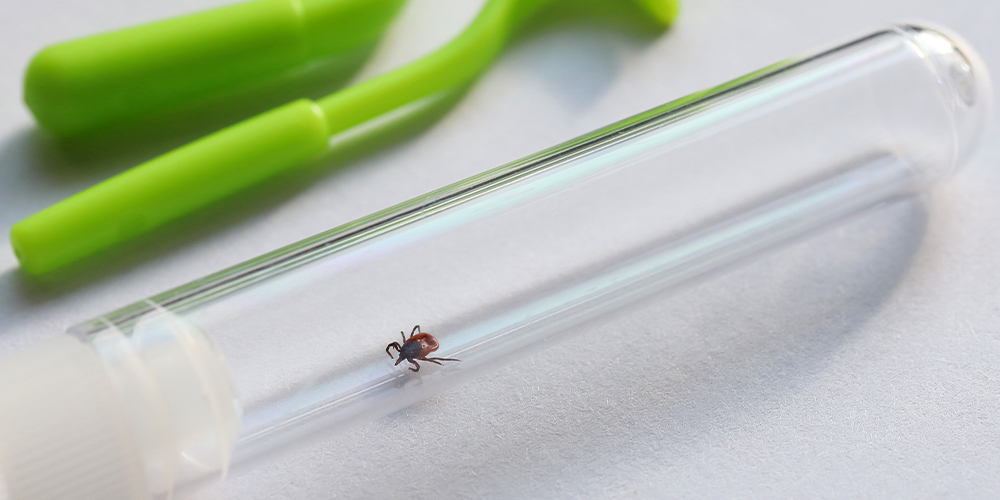
At the beginning of its life, a tick is barely visible, as the larva is no larger than a grain of sand. The nymph is roughly the size of a poppy seed, while an adult tick is about the size of an apple seed. An adult tick is dark brown or reddish in colour and can be identified by the following characteristics:
- Eight legs (except during the larval stage)
- No wings
- A body divided into two parts (head and abdomen)
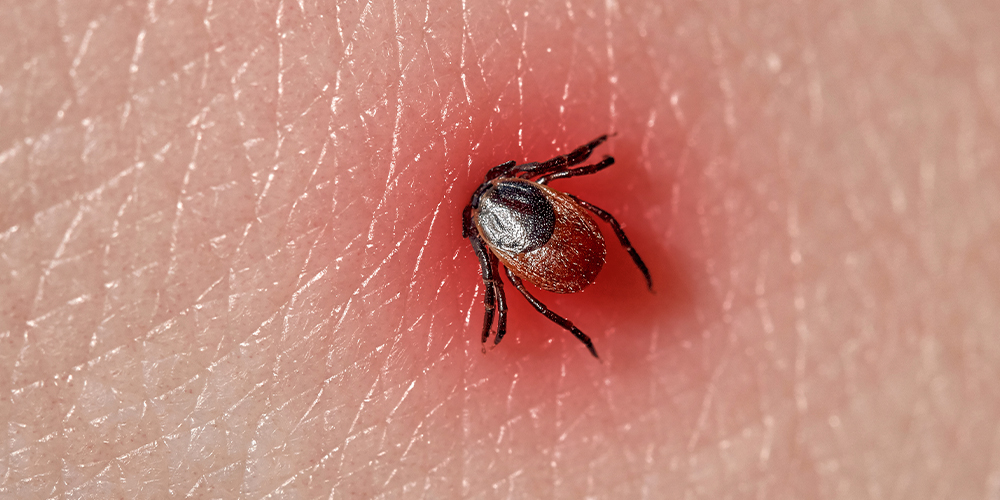
When a tick feeds, it engorges itself with its host’s blood and swells to a much larger size. As it becomes engorged, it appears more shiny and takes on an oval shape. On the skin or on a pet, it can sometimes be mistaken for a small bump.
Can ticks harm humans?
Ticks are known to carry pathogens. They can infect humans through prolonged attachment during a blood meal.
There are 40 tick species that can be found in Canada, but only two are the primary carriers of the Lyme disease bacteria: the blacklegged tick (deer tick) and the western blacklegged tick. Canada also has the American dog tick, which is not known for carrying Lyme disease but can carry other diseases such as Rocky Mountain spotted fever.
In 2025, there were 5,809 cases of Lyme disease reported in Canada. Nationally, this is a 10% increase over the previous year. The biggest increases were recorded in 2025 in Quebec and Ontario, with an increase of 27% in reported cases. For comparison, there were only 295 reported cases of West Nile virus in Canada during the same period. Ticks are a much bigger issue.
What are the most active months for ticks in Canada?
Usually, two-thirds of tick bites occur during the summer months, between June and August. But it’s important to remember that one-third of tick bites still occur in the cooler seasons. The risk exists as long as the outdoor temperature is above 4 °C.
People have reported seeing ticks in early spring, when there was still snow on the ground. And in many parts of British Columbia, ticks are active 12 months of the year.
Where are ticks most commonly found on the body?
It's important to know that ticks don’t jump. They are also much more common in bushes and grass than in trees. They climb plants and patiently wait for an opportunity to attach themselves to their hosts, which can be humans or wild or domestic animals. Once they have found a host, these parasites typically climb up to human knee and hip height.
“They are out there waiting for you to walk by. (…) Ticks are attracted to warm, moist areas of the body, and most likely climb to these areas on the body to feed,” explains Saravanan Thangamani, PhD in microbiology and immunology, director of the Center for Environmental Health and Medicine at the State University of New York (SUNY).
Make it a habit to check yourself and your children after any outdoor activity. Pay particular attention to the head, especially the hair around the ears, and to the armpits. Also check your dog for ticks. They can be difficult to find before they start feeding. Feel your skin for any bumps, and carefully examine every part of your body, looking for small black dots. Be vigilant! Most ticks are tiny!
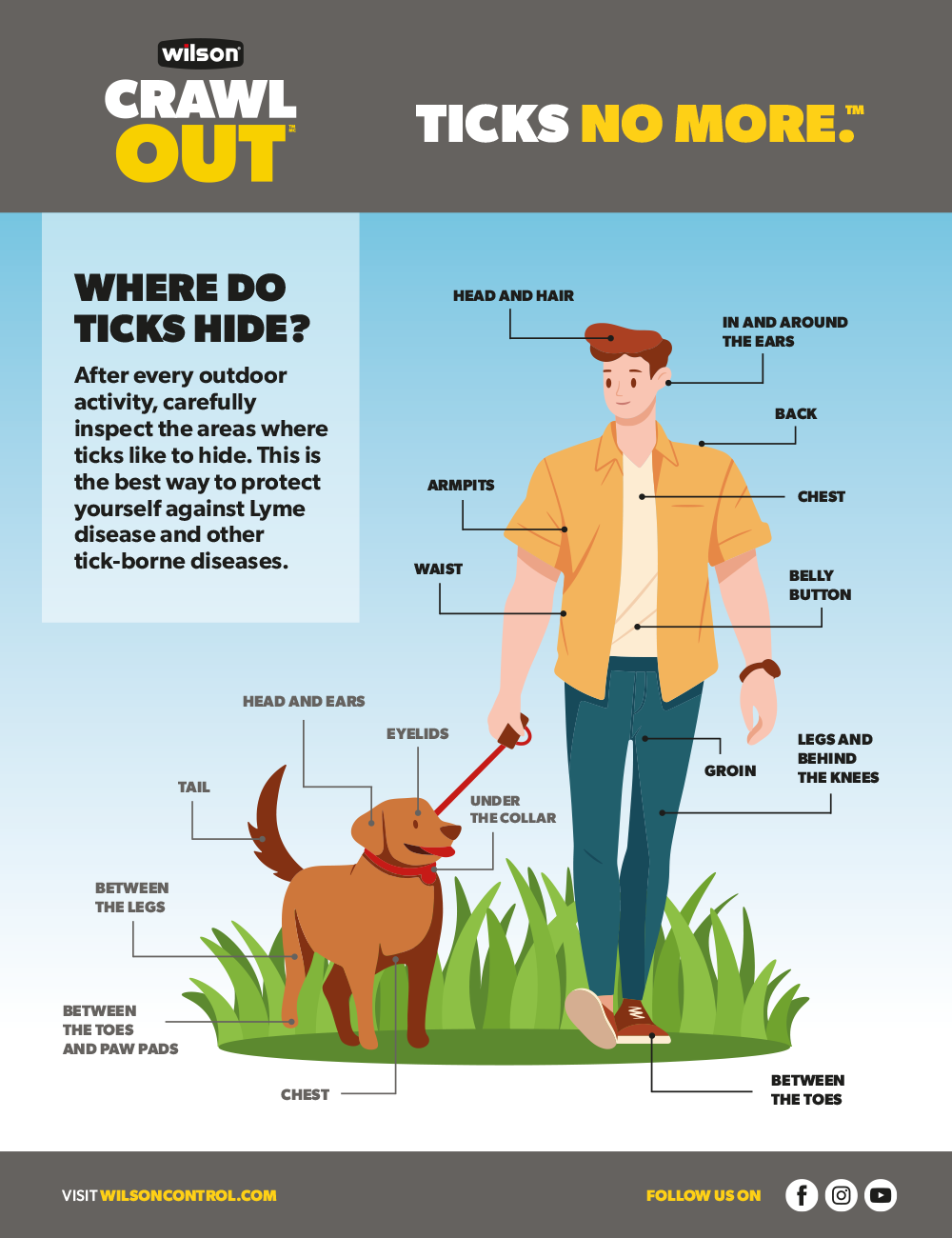
Download your information sheet now.
What to do if a tick is on you
Don’t panic if you discover a tick on yourself or your child. Sometimes, the tick hasn’t bitten yet. If you find a tick on yourself but no visible bite mark, it's best to check your entire body, not just the area where the tick is attached. The bite is usually painless and often goes unnoticed.
Unlike a mosquito, which bites and disappears right away, a tick attaches itself for several days to the skin of its victim to feed on its blood. To stay attached to you, a tick uses cement-like material and barbed mouthparts to adhere to your skin.
By examining the tick, you’ll see whether it’s attached to your skin or just crawling around looking for a spot, or if it has already satisfied its needs and is leaving. If it seems stuck, you should be able to see that the tick’s mouth is inside the skin, while the rest of its body is hanging off the skin.
Blacklegged ticks, also known as deer ticks, are those that most commonly bite humans. While they don't necessarily carry Lyme disease or any other tick-borne illness, it's important to remove ticks as soon as possible, ideally within 24 to 36 hours.
NOTE: If you find a fully engorged (swollen) tick walking on you, it means the tick has finished feeding on a host (you, a pet or another person) and has now detached. While it is not currently biting you, it’s important to check your body thoroughly for a bite site or if there are other, still-attached ticks.
Will ticks come off in the shower?
Showering within two hours of coming indoors has been shown to reduce your risk of getting Lyme disease and may be effective in reducing the risk of other tick-borne diseases. Showering may help wash off unattached ticks and it is a good opportunity to do a tick check.
How long does a tick stay attached to a human?
Its blood meal lasts approximately 3 to 7 days, depending on the stage of its molt, after which it detaches from its host and falls off.
How to remove a tick that's embedded?
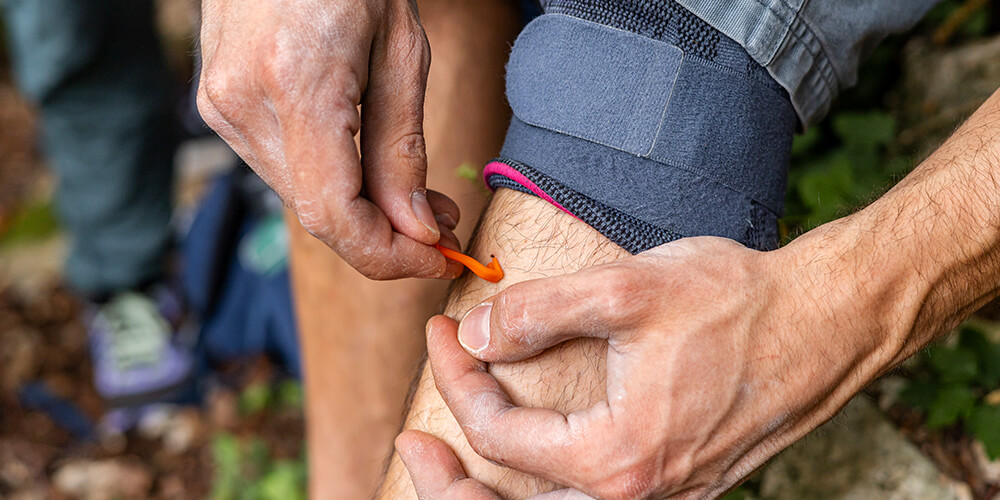
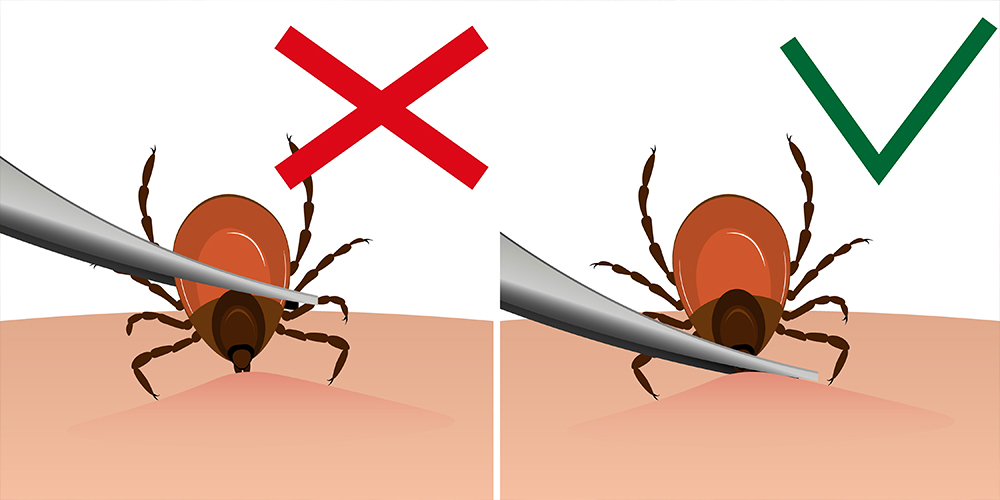
A tick should always be removed carefully. Don't crush it or tear it off. Make sure you remove the part of the tick embedded in the skin without breaking it. Attached ticks should be removed with fine-pointed tweezers or with special tools.
Remove it immediately (following the method recommended below) to prevent the risk of infection and Lyme disease.
- Using tweezers or a tick tool, grab the tick as close to your skin as possible. Try to grab the tick’s head, or directly above the head.
- Gently pull the tick straight up and out. You want it out in one piece. Do not twist. Try not to squeeze or crush the tick, since its bodily fluids may contain infection-causing pathogens. If done correctly, you avoid breaking up the tick and leaving part of it in your body.
What happens if part of a tick is left in the skin?
If the tick breaks apart while you are pulling it out, try to pull the rest of it out with tweezers, again grabbing as close to your skin as possible. If you cannot fully remove the tick part, you may want to go to the ER to see if they can fully remove it. If it can’t be fully removed, it might be okay to leave the part in your skin as it will eventually come out as the skin heals. In this state, the tick part cannot continue to transmit pathogens but be aware that it may have already infected you.
How do I disinfect a tick bite?
Wash the bite site with soap and water, or with alcohol or an antiseptic wipe. You can apply an over-the-counter antibiotic ointment (like Neosporin or Polysporin) to a tick bite after removing the tick and cleaning the area with soap and water. This helps prevent local skin infection and promotes healing, but it does not prevent tick-borne diseases like Lyme disease.
Contact your doctor or pharmacist as soon as possible after removing the tick.
For more information, consult:
https://www.canada.ca/en/public-health/services/diseases/lyme-disease/removing-submitting-ticks-testing.html
What to do with a tick after removal?
Some people simply flush the tick down the toilet. But diagnosis of the species is important. Place the tick inside a ziplock bag. If still alive, it is best to kill the tick intact (don’t squish it!), which can be done by placing the bag in the freezer or including an alcohol-based solution (such as hand sanitizer) in the bag. Take a photo of the tick in the bag.
Identify your tick!
You must determine if the tick is the problematic blacklegged tick (deer tick), or some other tick that doesn’t carry the Lyme disease pathogen. By identifying your bug, it will help to determine if it is the type of tick that can carry bacteria, viruses or parasites that cause tick-borne diseases.
You can identify a tick by taking a photo and sending it to an image-based identification platform like https://www.etick.ca/en/content/photographic-guide or you can contact your provincial and territorial public health authorities to find out about tick identification programs in your area.
A few useful links
https://www.canada.ca/en/public-health/services/diseases/ticks-tick-borne-diseases/ticks.html
https://www.inspq.qc.ca/en/identification-guide-ticks-found-quebec
https://ncceh.ca/resources/evidence-reviews/review-ticks-canada-and-health-risks-exposure
For more information to learn how to protect your home and garden from ticks, read: Comment protéger la maison et le jardin contre les tiques avec CRAWL OUT