

There was a time when we never really thought about ticks except when we were going on hikes in the woods or spending some time out camping. Things have changed. Ticks have spread into most provinces, moving northward about 35 km every year. No longer confined to the wilderness, you can encounter ticks in your own lawn and garden.
The good news is that there are simple interventions that you can do to reduce tick exposure to create a perimeter barrier around your yard. We will explain how in this article.
What time of year are ticks a concern?
Ticks are active whenever temperatures are over 4 °C. You’ll find that two-thirds of tick activity occurs between June and August. However, they are definitely around in the early spring and late fall.
An overwintering female will lay her eggs early in the spring. These parasites go through a two-year life cycle, hatching in year 1 from egg to six-legged larvae and moving to year 2 as eight-legged nymphs and adults. During the season, you can find new larvae and nymphs/adults from the previous year both active at the same time, waiting for you, your family and your pets.
Where are the ticks?
Transported by deer, but also by rodents and birds, ticks can be everywhere. Of course, they love gardens that resemble a jungle. Disliking sunlight and dry air, they prefer shady and moist areas, and places that offer plenty of hiding possibilities: tall grass that reaches your ankles, an overgrown hedge that blocks your view from the neighbours, piles of leaves left in a corner since last fall, the back of the shed where weeds have taken over, etc.
As ticks can’t fly or jump, they simply hitch onto a passing body.
Tip: If you are hiking in a wooded area, stay in the centre of trails, and away from the tall vegetation on the edges. At home, cover your skin and use a tick repellent when you are gardening.

What repels ticks in a yard?
Ticks prefer moist, shady areas, so think sunny. Ticks don't do well in dry, open areas. You can help create a tick-safe zone by adjusting your landscaping and maintenance.
- Keep your lawn mowed. Ticks don’t like short grass. Mow it short, about 3 inches or less.
- Clear brushes and weeds on edges of your property, along stone walls, fences, etc.
- Trim shrubs and trees to minimize shade and prevent lower branches from touching the ground.
- Reduce vegetation and litter around decks and patios.
- Rake up leaves and debris.
- Stack firewood away from your active areas. Rodents are attracted to piles of wood, and ticks… to rodents!
- Lawn furniture and playground equipment should be set back from the edge of wooded, shady areas.
- Considering that in the early stages of the tick, the life cycle involves their larvae latching onto small mammals such as mice and squirrels, look for ways to keep those rodents out of your yard.
- Install playsets on a wood chip mulch surface instead of grass.
- Create a one-metre buffer of mulch or gravel between your lawn and any shrubs, stone walls and forested areas.
Treat vegetation with tick spray to create a perimeter barrier
To help control ticks in outdoor activity areas, treat a band of vegetation and leaf litter 2-3 metres wide (6-10 feet), especially where dense vegetation occurs. Wilson CRAWL OUT is registered for tick control.
CRAWL OUT can be applied as early as May or the beginning of June. The treatment can be repeated after 7 days in sunny areas or if it has rained, or after 14 days in shaded areas (the product's effect lasts longer in the shade and in the absence of rain). In regions where ticks are less of a problem, the treatment can be repeated at the end of summer or the beginning of fall.
How to protect yourself from ticks when you go outside
Here are some precautions to take when engaging in outdoor activities:
- Put on long-sleeved clothing and pants.
- Tuck in your shirt and pull your socks over the cuffs of your pants.
- Wear light-coloured clothes so any ticks that land on you are easy to spot.
- Do not wear sandals or open-toe shoes.
- Apply DEET or icaridin insect repellents to clothing and any exposed skin.
- You can buy insecticide-treated clothing designed to repel ticks and mosquitoes.
For more information, read: https://www.canada.ca/en/public-health/services/publications/diseases-conditions/lyme-pamphlet.html
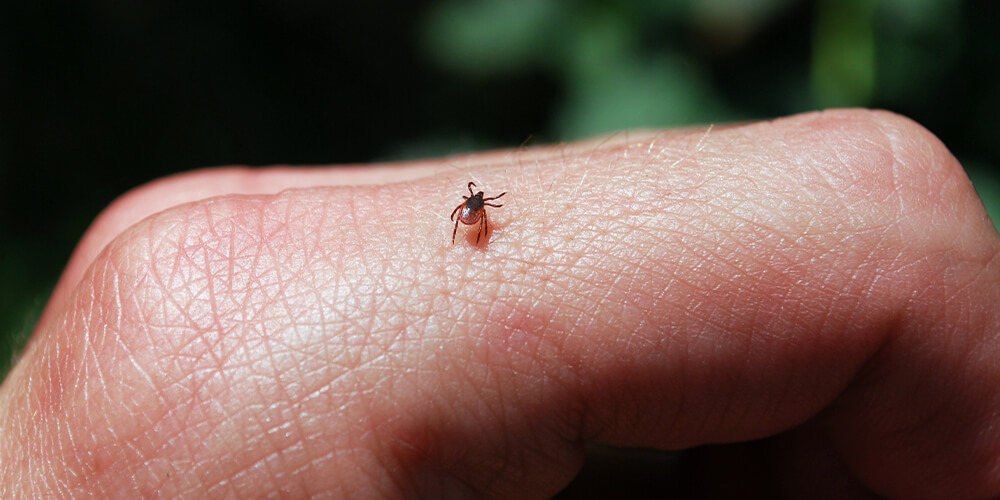
How to keep ticks from coming into the house?
Before going back inside your home, check each other’s clothes and heads for tick hitchhikers. Also look over any of your outdoor equipment, and don’t forget to inspect your pet. Consult our guide to be sure to check every area ticks can hide on you or your dog.
Once indoors, if you have any concerns, put your clothes in the dryer. Ten minutes of heat kills ticks. Take a shower within 2 hours of outdoor activity to wash off any unattached ticks. When you remove your clothing, check your body. Learn how to remove a tick properly and safely in our other article.
Inspect your pets by running your fingers through their fur to feel for small, unusual bumps.
Wash your pet's bed in hot water and treat it with approved parasiticides such as CRAWL OUT. Once the bed is treated, do not allow your pet to use it for 7 days.
IMPORTANT: Do not spray CRAWL OUT directly on animals. To protect or treat your pet, use a product specifically designed for that purpose.
For more information on ticks, go to links: Ticks: what you should know and Be aware of ticks!
What should you do if you think there are ticks in your home?
A typical house is not a favourable environment for ticks, but vigilance is still necessary, especially if you have pets, if you go camping or hiking in the forest, or if you live in an area where ticks are very present.
A tick that falls from your clothes or pet will usually die within 24 to 72 hours if it doesn't find a host in the warm and dry environment of a typical home. However, a tick attached to a pet can survive much longer and lay eggs in your home if it isn't removed promptly.
Here are some precautions to take if you have found a tick or if you think there may be ticks in the house.
- Wash and dry your clothes and bedding at a high temperature (minimum 60 °C).
- Vacuum thoroughly (floors, furniture, carpets, crevices) and dispose of the vacuum bag in an airtight container outdoors.
- Apply CRAWL OUT to floors, under furniture, along baseboards, and in the bathroom (ticks prefer humid environments).
- Inspect and treat your pets with a parasite control product recommended by your veterinarian.
- Treat your pets' beds with CRAWL OUT.
- Fix the moisture problems in your home; dry air is your best ally!
